
All hobbies › Soba Noodle Making
Soba Noodle Making 蕎麦打ち
A hobby where you knead buckwheat flour and water, roll and cut the dough, and make and eat your own soba noodles.
- Cost
- ¥20,000–¥30,000 (tools) / about ¥1,000 for 500 g of buckwheat flour
- Time
- 1–2 times a month, 2–3 hours each
- First step
- Make soba once at a hands-on class
Why people love soba noodle making
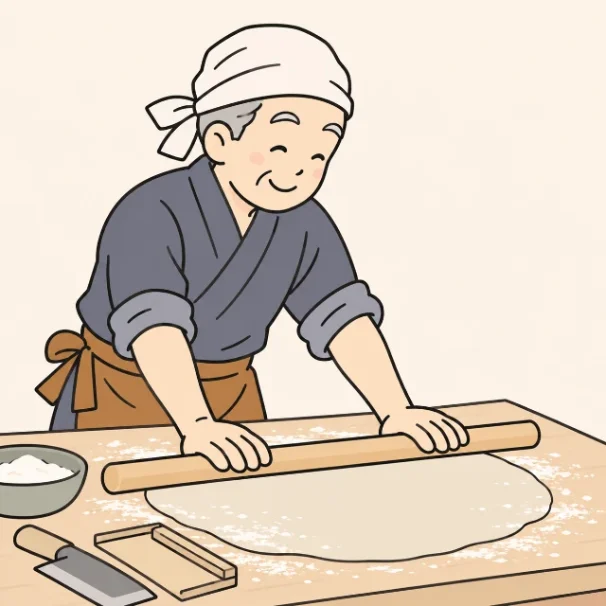
Mixing 80% buckwheat flour with 20% wheat flour, called "nihachi," is an easy ratio to work with. Adding water little by little and working it into the flour with your fingertips, called "mizumawashi," is the first big hurdle of soba making. After you form it into one ball and knead it, you roll it out with a rolling pin and shape it into a square. You fold the dough and cut it with a knife along a guide board, and the sound is a light, pleasant tapping. Freshly boiled soba tastes completely different from store-bought noodles. Even uneven, imperfect noodles somehow taste great when you made them yourself. The smell of the flour rising is a pleasure only the maker gets.
How to start
- Look up classes or facilities that offer soba-making experiences
- Pick a date, sign up, and check what to bring
- At the class, make soba from mixing in the water to rolling out the dough
What you need
- Must have: Buckwheat flour, wheat flour (as a binder), a mixing bowl, a rolling board, a rolling pin, a knife
- Nice to have: A guide board (komaita), a soba-cutting knife, a rolling board
- Not needed at first: Expensive professional tools
From beginner to advanced
- BeginnerUp to ¥30,000
Next challenge: The dough won't hold together or cracks, because the water amount is off
- IntermediateA few thousand yen a month (flour and classes)
Next challenge: Making the thickness of the rolled dough and the noodle width even
- AdvancedClasses from ¥10,000 a month
Next challenge: Telling flours apart, and making 100% buckwheat soba and soba from each region
Tips
- Don't add the water all at once. Add it in several rounds with a spray bottle or your hand, and the flour takes up water evenly and the dough holds together better.
- Check the thickness of the rolled dough by laying boards of the same width on both sides. This makes it easier to cut noodles of an even thickness.
- Write down the weather, the amount of flour, and the amount of water each time. It helps you adjust the next day, and you improve faster.
FAQ
How old do you have to be to make soba?
Elementary school children can try kneading the dough. For the cutting step, which uses a knife, they should work with an adult.
What tools do I need to make soba?
At first, the tools at a hands-on class are enough. If you continue, get a mixing bowl, a rolling pin, a rolling board, a knife, and a guide board.
How much does soba making cost?
500 g of buckwheat flour costs ¥800–¥1,200. A full set of tools is about ¥20,000–¥30,000, and a hands-on class costs ¥4,000–¥6,000.
I'm worried about allergies. Is soba safe?
Buckwheat can cause food allergies. Always check that you, your family, and everyone taking part have no allergy.
My soba dough turned out hard. What went wrong?
Often there was too little water or the dough was not kneaded enough. Add water a few grams at a time and check the dough as you go.
Similar hobbies
Costs and steps are typical examples in Japan and can vary. 日本語のページ