
All hobbies › Shogi
Shogi 将棋
A hobby where you play a two-player thinking game on a board, reading each move to checkmate your opponent's king.
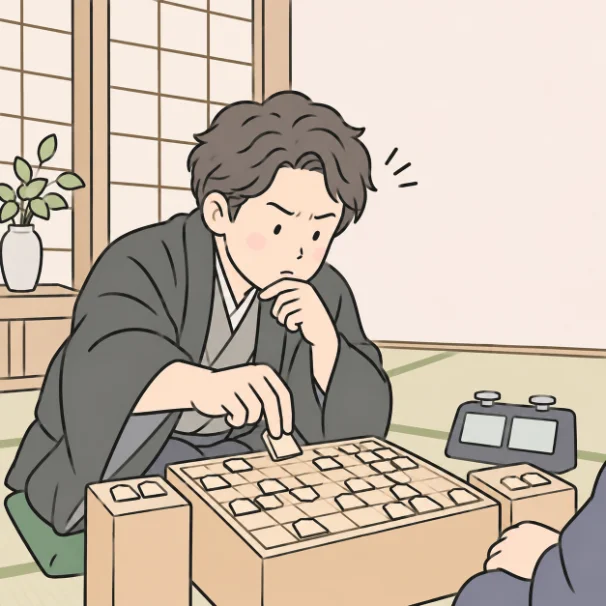
- Cost
- ¥0 and up (with an app) / a few thousand yen and up for a board and pieces
- Time
- 10 to 30 minutes per game, several times a week
- First step
- Learn how the pieces move
Why people love shogi
Shogi is a two-player thinking game where you move pieces on a board to checkmate your opponent's king. Each of the 8 kinds of pieces moves in a fixed way, so the rules are simple, but the number of possible positions is huge. On every move you read your opponent's next move and then move your own piece, which takes focus. When you look back at a lost game, you can study which move was bad and use it in the next game. With apps and online play, you can find opponents at any time. You can start once you know how the pieces move, and as your skill grows, games get deeper and more fun.
How to start
- Learn how the pieces move from a beginner book or videos (8 kinds: king, rook, bishop, gold, silver, knight, lance, and pawn)
- In a shogi app's beginner course, play 10 games against the computer on a weak setting such as a handicap (komaochi, where the computer starts with fewer pieces)
- Solve one tsume-shogi (checkmate puzzle, 3 moves) every day, and learn the patterns of checks in one week
What you need
- Must have: A shogi board and pieces (or an app), a beginner book
- Nice to have: A tsume-shogi puzzle book, a notebook to record games
- Not needed at first: Expensive gear, such as a high-end kaya wood board, while you are a beginner
From beginner to advanced
- Beginner¥0 and up
Next challenge: Piece moves and basics
- IntermediateA few thousand yen
Next challenge: How to read moves
- AdvancedTens of thousands of yen
Next challenge: Sharpening skills at tournaments and clubs
Tips
- Even one game a day builds your sense of reading ahead more than wins or losses do. The more you play, the better you read the board, and winning positions slowly increase.
- After a lost game, look back at just one move that went wrong. Making review a habit reduces repeated mistakes, so you learn from every game.
- Solve one tsume-shogi a day and your endgame will grow stronger. Your eyes get used to the shapes, so you can stay calm in real games. Starting with short puzzles is a good idea.
FAQ
What should I learn first in shogi?
Start with how the pieces move. Once you know the 8 kinds of pieces, you can play beginner apps. There are many beginner books and videos too.
What if I have nobody to play with?
You can play the computer in an app or play online. If you join a local shogi class or a shogi club (dojo), you can play with other beginners.
The rules look hard.
Learn the pieces little by little and you will be fine. At first it is enough to be aware of which pieces you can capture and which can capture you.
How can I get stronger?
Solve tsume-shogi every day and review your lost games. Reading one book on opening patterns (joseki) is also a shortcut.
How much do a shogi board and pieces cost?
A beginner folding board and pieces start from about ¥1,000 to ¥3,000. A proper wooden set costs tens of thousands of yen or more.
How is shogi different from Go and chess?
In shogi, a piece you capture can be used as your own piece. In chess, captured pieces leave the board, and Go is a game of surrounding territory with stones.
Similar hobbies
Costs and steps are typical examples in Japan and can vary. 日本語のページ