
All hobbies › Origami
Origami 折り紙
A hobby where you fold a single square sheet of paper, with no scissors or glue, into cranes, other animals or flowers.
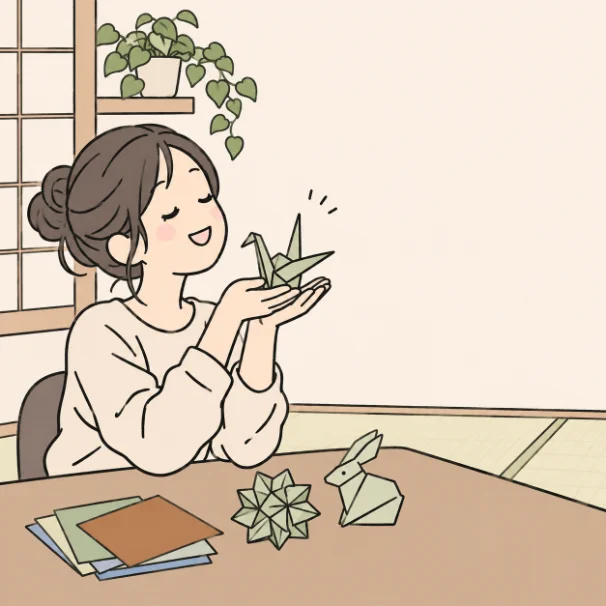
- Cost
- ¥0 and up (serious folders up to ¥5,000)
- Time
- Once a week for 15 minutes or more, in spare moments
- First step
- Fold one paper crane
Why people love origami
At the last step of the crane, when you pull the neck up, a plain square of paper suddenly stands up as a bird with spread wings. You need no scissors or glue; the shape comes only from the angles of your folds and how you shift the paper. Even with the same steps, the thickness of the paper changes the result, and you can enjoy how the paper feels as it changes in your hands. You may be surprised that your fingers still remember the crane you folded as a child. A small crane folded while waiting for a train can become a gift added to a letter to a friend. All you need is one sheet of paper, so you can start the moment you feel like it.
How to start
- Pick a book or video with folding diagrams and decide what you want to fold.
- Get a square sheet of paper and a flat table for sharp creases.
- Fold one crane by following the diagram.
What you need
- Must have: Square origami paper, a book or video showing how to fold
- Nice to have: A bone folder for creases, thin washi paper, tweezers
- Not needed at first: Expensive special paper, a large work table
From beginner to advanced
- Beginner¥0 to ¥500
Next challenge: Corners don't line up and the shape gets crooked
- Intermediate¥500 to ¥2,000
Next challenge: You can't read complex folding diagrams
- Advanced¥2,000 and up
Next challenge: Managing paper thickness and creases is hard
Tips
- For your first crease, match the corners and push outward with the pad of your finger to line them up exactly. If this is off, the shape will be out of line to the end, so go carefully. Clean creases make a big difference in how it looks.
- If you fold the same model three times, your hands remember the steps and the shape improves. The first time you learn, the second time you improve accuracy, and the third time you see your own speed. With repetition, your fingers move naturally.
- Fold the same model with large and small paper to compare. The thickness changes how easy it is to fold, so you also learn which paper suits fine work. As your sense for paper grows, your range of work widens.
FAQ
How old do you have to be?
From around age 3 you can play with simple shapes. Complex models are more fun from elementary school age, once you can read folding diagrams.
Can I do it alone?
Yes. With a book or a video you can fold anywhere with one sheet. Folding side by side with someone is also a nice time.
How much does it cost?
Origami paper from a ¥100 shop is enough. Even if you later want thin washi or large paper, a few thousand yen covers it.
Can I fold if I'm not good with my hands?
The key is to line up the first folds carefully. Match corner to corner exactly and press the crease with your fingernail.
I can't read the folding diagrams.
The meaning of the dotted lines and arrows is explained in the first few pages. Folding along with a video is the quickest way to learn.
Similar hobbies
Costs and steps are typical examples in Japan and can vary. 日本語のページ